
 By
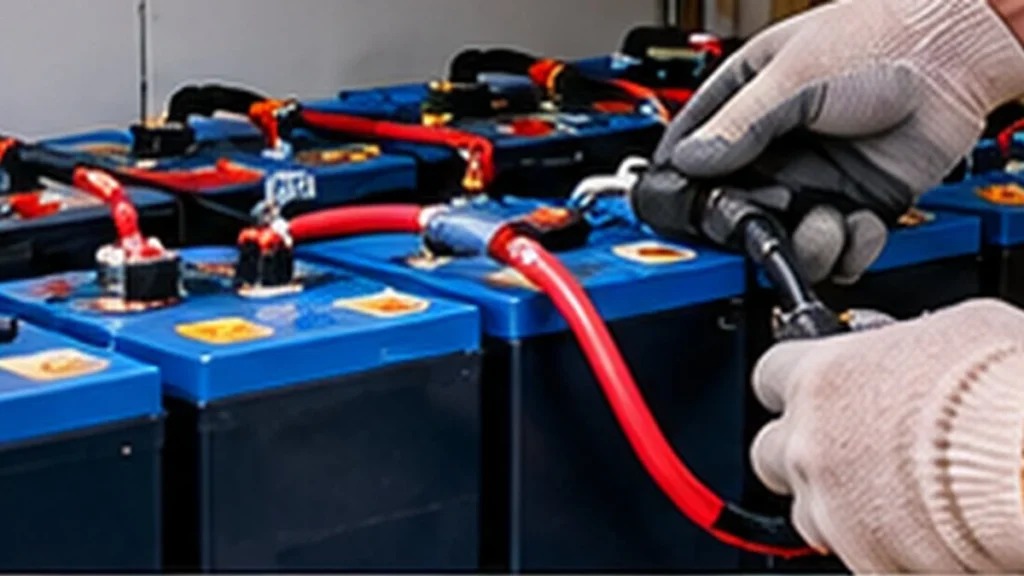
Knowing how to wire batteries in series and parallel is key. Series wiring adds voltage. Connect positive to negative. Two 12 V 100 Ah batteries become 24 V 100 Ah. Amp-hours stay the same. Parallel wiring adds amp-hours. Connect positive to positive, negative to negative. Two 12 V 100 Ah batteries become 12 V 200 Ah. Voltage stays the same. Total energy is always 2.4 kWh.
Battery series / parallel calculator
Estimates use the formulas explained in this guide. Plan a complete system with the all-in-one calculator →
Series wiring
How to connect: link the positive (+) terminal of battery 1 to the negative (−) terminal of battery 2. The system’s output is battery 1’s negative and battery 2’s positive.
| Batteries (12 V 100 Ah each) | Result |
|---|---|
| 2 in series | 24 V 100 Ah (2.4 kWh) |
| 4 in series | 48 V 100 Ah (4.8 kWh) |
Use series to build 24 V or 48 V systems from 12 V batteries. See 12V vs 24V vs 48V.
Parallel wiring
How to connect: link all positive terminals together and all negative terminals together.
| Batteries (12 V 100 Ah each) | Result |
|---|---|
| 2 in parallel | 12 V 200 Ah (2.4 kWh) |
| 4 in parallel | 12 V 400 Ah (4.8 kWh) |
Correct layout: take the main positive from one end of the bank and the main negative from the opposite end (diagonal connection), or better, connect every battery to a positive and negative busbar using cables of identical length. If you take both main cables from the same battery, that battery works harder and wears out first.
Series-parallel
Build identical series strings first, then connect the strings in parallel.
Example: eight 12 V 100 Ah batteries as 24 V 400 Ah = four strings of two in series, all four strings in parallel via busbars. Total 9.6 kWh.
Rules for any bank
- Same type, capacity, brand and age. Mixing causes the weakest battery to be overcharged or over-discharged. See mixing old and new batteries.
- Charge each battery fully and individually before connecting, so they start at the same state of charge.
- Identical cable lengths and sizes between batteries and busbars.
- Fuse each parallel string, especially with three or more strings, so a short in one battery cannot draw the whole bank’s current through it.
- Tighten terminals to the specified torque; loose connections cause heat and voltage drop.
Extra rules for lithium (LiFePO4)
- Check series limits. Many 12 V lithium batteries allow up to four in series (48 V); some allow none, especially those with Bluetooth BMS boards. Read the data sheet.
- Parallel limits also vary, often four to sixteen batteries.
- Balance before series connection: charge each battery to full separately, then connect. Some manufacturers recommend periodic individual top-ups or offer communication cables for active balancing.
- For 48 V systems, a single 48 V (51.2 V) rack battery is usually simpler and better balanced than four 12 V batteries in series.
Extra rules for lead-acid
- Lead-acid series strings drift out of balance over time; equalise flooded batteries periodically per the maker’s instructions. See lead-acid battery maintenance.
- Avoid more than about three parallel strings; current sharing gets worse.
Safety
- Remove rings and watches; use insulated tools. A dropped spanner across terminals can deliver thousands of amps.
- Connect the main fuse and battery disconnect last; disconnect them first when working.
- Size cables and fuses for the inverter’s maximum current. See battery cable and fuse size.
Once your bank is designed, check its capacity against your daily use with the solar calculator.

Worked example: building a 24 V 300 Ah bank from 12 V batteries
You have six identical 12 V 100 Ah LiFePO4 batteries.
- Charge each battery fully on its own until the charger finishes, then let them rest an hour.
- Make three series pairs: battery A positive to battery B negative, and so on, creating three 24 V strings.
- Fuse each string on its positive output (for example 150 A for a 100 A BMS string).
- Connect each string to a positive busbar and a negative busbar with cables of identical length and gauge.
- Connect the busbars to the system through the main Class T fuse and battery switch.
- Verify with a meter: about 26 to 27 V across the busbars, and the same voltage on each string.
Result: 24 V, 300 Ah, about 7.7 kWh, with up to 300 A of continuous current.
Wiring diagrams in words
Series (2 batteries): Batt1 − → system negative; Batt1 + → Batt2 −; Batt2 + → system positive.
Parallel (2 batteries, diagonal): Batt1 + ↔ Batt2 +; Batt1 − ↔ Batt2 −; system positive from Batt1 +; system negative from Batt2 −.
Parallel with busbars (best): each battery + to the positive busbar through its own fuse; each battery − to the negative busbar; system cables from the busbars.
Checking balance after installation
- After a few cycles, check each battery’s or string’s voltage at rest; they should match within a few hundredths of a volt.
- With lithium, check each battery’s app for SoC differences. A gap that keeps growing suggests a cable or connection problem, or a weaker battery.
Common mistakes
- Connecting a series string backwards (positive to positive), creating a dead short.
- Different cable lengths between batteries in parallel.
- Mixing a fully charged battery with a flat one, causing huge balancing currents.
- Exceeding the manufacturer’s series limit for lithium batteries.
FAQ
Do batteries last longer in series or parallel?
Neither by itself. What matters is matched batteries, balanced charging and good cabling.
Can I wire different capacity batteries in parallel?
Same-chemistry, same-voltage batteries can technically be paralleled, but it is not recommended; the smaller one cycles deeper and ages faster.
How do I get 24 V from 12 V batteries?
Connect two 12 V batteries in series: positive of one to negative of the other.
How do I wire four 12 V batteries for 48 V?
All four in series: positive of each to the negative of the next, using the first battery’s negative and the last battery’s positive as the system terminals.
Can I wire batteries in series and parallel at the same time?
Yes, that is series-parallel: build identical series strings first, then connect the strings in parallel.
Related guides
- Battery Voltage Chart for 12V, 24V and 48V (LiFePO4 and Lead-Acid)
- LiFePO4 vs AGM Batteries for Solar: Which Is Better?
- Depth of Discharge (DoD) Explained for Solar Batteries
- How Many Batteries Do I Need for a 3,000W Inverter?
Sources and further reading
- NFPA: Understanding NFPA 70, the National Electrical Code: the US wiring code that covers solar and batteries.
- Battery University: BU-205 Types of Lithium-ion: how lithium chemistries, including LiFePO4, compare.
- Battery University: BU-409b Charging Lithium Iron Phosphate: LiFePO4 charging voltages and behaviour.